
Beginner
Product Management
The whole product lifecycle, from finding an opportunity through discovery, specification, prioritization and delivery, to launch and the iteration that follows it. Weighted toward the artifacts a working product manager is judged on: the PRD, the roadmap, the backlog, the metric, the launch plan.
- 59 lessons
- Beginner
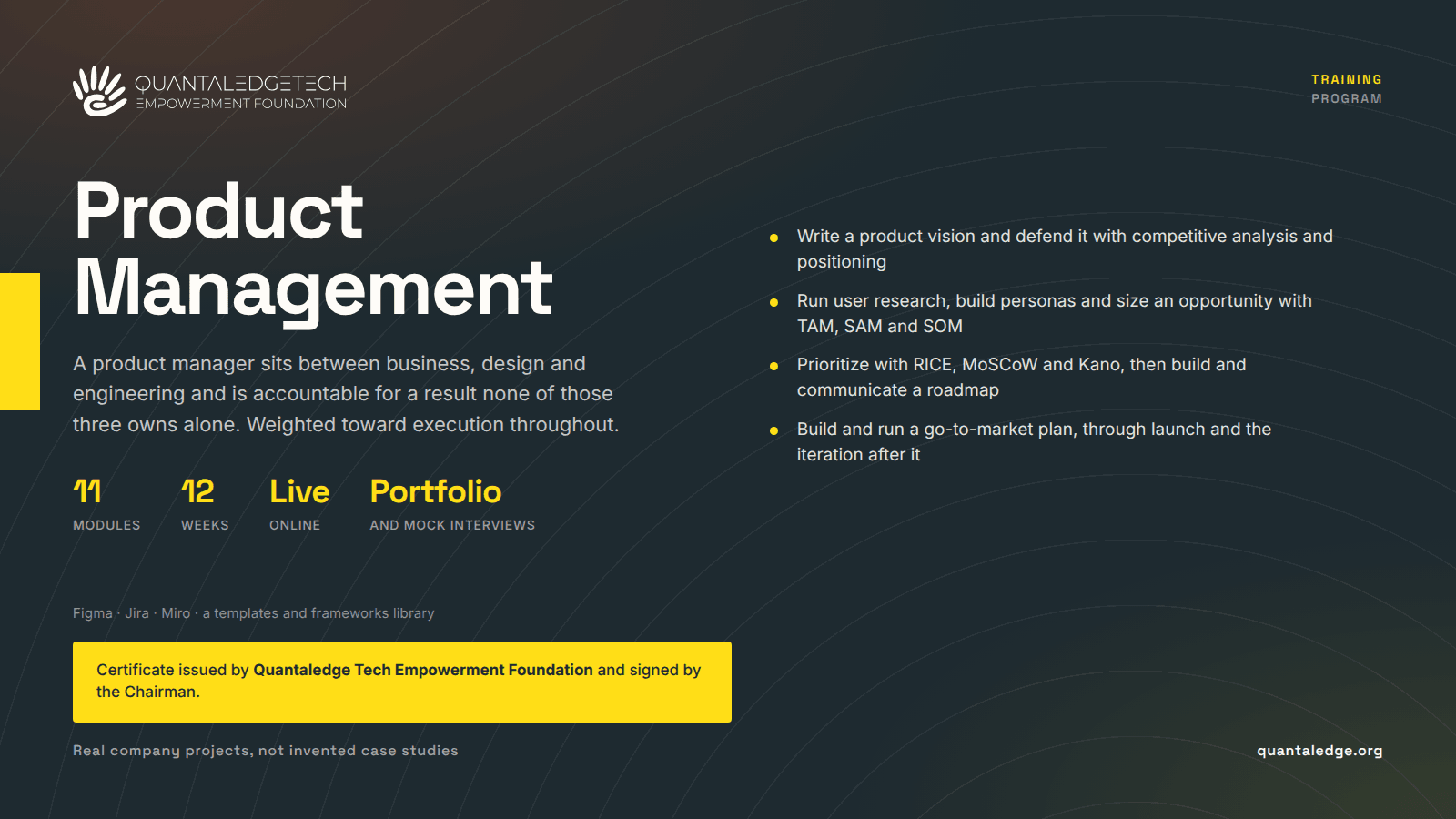
A product manager sits between business strategy, design and engineering and is accountable for a result none of those three owns alone. This course covers the whole product lifecycle, from finding an opportunity to the iteration that follows a launch.
It is deliberately weighted toward execution. Strategy frameworks are taught, but so are the artifacts a working product manager is judged on: the PRD, the roadmap, the backlog, the metric, the launch plan.
What a graduate can do
- Say precisely what a product manager does, how the role differs from project management, and which product manager archetype a given job is describing.
- Write a product vision and strategy, and defend it with competitive analysis and positioning using Porter's Five Forces, Blue Ocean Strategy and SWOT.
- Run user research, build personas and journey maps, apply jobs-to-be-done, and size an opportunity with TAM, SAM and SOM.
- Validate a problem before building, run structured ideation and design thinking, scope an MVP, and test it through prototypes.
- Write a product requirements document, user stories and acceptance criteria, and produce wireframes and design briefs a designer can work from.
- Prioritize with RICE, MoSCoW, the Kano model and value against effort, then build and communicate a roadmap and keep a backlog healthy.
- Work inside Scrum with an engineering team, through sprint planning, story grooming, release planning and velocity.
- Instrument a product and read it, using a north star metric, the AARRR framework, analytics tooling, A/B tests, funnels and cohorts.
- Apply UX principles, run usability testing, shape information architecture and user flows, and account for accessibility.
- Hold a credible technical conversation about APIs, databases, cloud computing, system architecture and technical debt.
- Build and run a go-to-market plan, position and message the product, run a beta, and iterate after launch.
How it is taught
Twelve weeks, three sessions a week of two to three hours, online and instructor-led, with a self-paced track alongside it. Learners work in Figma, Jira and Miro against a library of product management templates and frameworks, on product development projects with real companies rather than invented case studies.
Assessment and certification
Project work throughout, plus mock interviews and case study practice sessions of the kind used in product management hiring. Work produced during the course is shaped into a portfolio.
Finishing the course does not produce a certificate on its own. The certificate is issued by Quantaledge Tech Empowerment Foundation and carries the signature of the Chairman.
Before you start
None, though the course is aimed at people already working in engineering, design, marketing, analysis or operations.
What the course covers
11 modules · 59 lessons
1. Introduction to product management
What the role is and how it differs from project management, the B2B, B2C, platform, growth and technical archetypes, the essential competencies, and the career paths open.
- What product management is and what the product manager doesEnroll to open
Reading · optional
- Product manager against project manager: the key differencesEnroll to open
Reading · optional
- Types of product manager: B2B, B2C, platform, growth, technicalEnroll to open
Reading · optional
- Essential skills and competenciesEnroll to open
Reading · optional
- Career paths and opportunitiesEnroll to open
Reading · optional
2. Product strategy and vision
Writing a vision and mission, Porter's Five Forces, Blue Ocean Strategy and SWOT, competitive analysis and positioning, alignment to business objectives, and communicating a roadmap.
- Writing a product vision and missionEnroll to open
Reading · optional
- Strategic frameworks: Porter's Five Forces, Blue Ocean Strategy, SWOTEnroll to open
Reading · optional
- Competitive analysis and market positioningEnroll to open
Reading · optional
- Aligning product strategy to business objectivesEnroll to open
Reading · optional
- Building and communicating a product roadmapEnroll to open
Reading · optional
3. Understanding users and market research
Interviews, surveys and focus groups, personas and customer journey maps, jobs-to-be-done, market sizing with TAM, SAM and SOM, and competitive analysis.
- Research methods: interviews, surveys, focus groupsEnroll to open
Reading · optional
- User personas and customer journey mapsEnroll to open
Reading · optional
- Jobs-to-be-done and identifying user needsEnroll to open
Reading · optional
- Market sizing and opportunity assessment: TAM, SAM, SOMEnroll to open
Reading · optional
- Competitive and market analysisEnroll to open
Reading · optional
4. Product discovery and ideation
Opportunity identification and problem validation, brainstorming and design thinking, lean product development and build-measure-learn, defining an MVP, and prototyping and concept testing.
- Opportunity identification and problem validationEnroll to open
Reading · optional
- Ideation: brainstorming, design thinking, innovation workshopsEnroll to open
Reading · optional
- Lean product development and the build-measure-learn cycleEnroll to open
Reading · optional
- Defining and validating a minimum viable productEnroll to open
Reading · optional
- Prototyping and concept testingEnroll to open
Reading · optional
5. Product requirements and specifications
Writing a PRD, user stories and acceptance criteria, feature and technical specifications, wireframing in Figma, Sketch and Adobe XD, and working with designers.
- Writing an effective product requirements documentEnroll to open
Reading · optional
- User stories, acceptance criteria and use casesEnroll to open
Reading · optional
- Feature specifications and technical requirementsEnroll to open
Reading · optional
- Wireframing and mockups in Figma, Sketch and Adobe XDEnroll to open
Reading · optional
- Working with designers and writing design briefsEnroll to open
Reading · optional
6. Prioritization and roadmapping
RICE, MoSCoW, Kano and value against effort, building and maintaining a roadmap, balancing stakeholder demand against technical debt, and managing a backlog.
- Prioritization frameworks: RICE, MoSCoW, Kano, value against effortEnroll to open
Reading · optional
- Building and maintaining a roadmapEnroll to open
Reading · optional
- Balancing stakeholder demand against technical debtEnroll to open
Reading · optional
- Communicating a roadmap to different audiencesEnroll to open
Reading · optional
- Managing a product backlogEnroll to open
Reading · optional
7. Agile product development
Agile principles and the product manager's role in Scrum, sprint planning, standups and retrospectives, grooming user stories, release planning, and agile metrics and velocity.
- Agile principles and the product manager's role in ScrumEnroll to open
Reading · optional
- Sprint planning, daily standups and retrospectivesEnroll to open
Reading · optional
- Writing and grooming user storiesEnroll to open
Reading · optional
- Working with engineering teamsEnroll to open
Reading · optional
- Release planning and version managementEnroll to open
Reading · optional
- Agile metrics and velocityEnroll to open
Reading · optional
8. Data-driven product management
North star metric and the AARRR framework, Google Analytics, Mixpanel and Amplitude, A/B testing and experimentation, cohort and funnel analysis, and product health dashboards.
- Product metrics and KPIs: the north star metric, the AARRR frameworkEnroll to open
Reading · optional
- Analytics tooling: Google Analytics, Mixpanel, AmplitudeEnroll to open
Reading · optional
- A/B testing and experimentationEnroll to open
Reading · optional
- Cohort analysis and funnel optimizationEnroll to open
Reading · optional
- Interpreting data and telling the story it supportsEnroll to open
Reading · optional
- Dashboards and product health trackingEnroll to open
Reading · optional
9. User experience and design thinking
UX principles for product managers, the design thinking process, usability testing and user feedback, information architecture and user flows, and accessibility and inclusive design.
- UX principles for product managersEnroll to open
Reading · optional
- The design thinking process in practiceEnroll to open
Reading · optional
- Usability testing and collecting user feedbackEnroll to open
Reading · optional
- Information architecture and user flowsEnroll to open
Reading · optional
- Accessibility and inclusive designEnroll to open
Reading · optional
- Collaborating with UX and UI designersEnroll to open
Reading · optional
10. Technical fundamentals for product managers
The software development lifecycle, APIs, databases and cloud computing basics, system architecture and scalability, technical debt and engineering trade-offs, and communicating with engineers.
- The software development lifecycleEnroll to open
Reading · optional
- APIs, databases and cloud computing basicsEnroll to open
Reading · optional
- System architecture and scalabilityEnroll to open
Reading · optional
- Technical debt and engineering trade-offsEnroll to open
Reading · optional
- Communicating effectively with engineersEnroll to open
Reading · optional
11. Go-to-market strategy and product launch
Building a go-to-market strategy, positioning and messaging, launch planning and execution, working with marketing, sales and customer success, beta programs, and post-launch iteration.
- Building a go-to-market strategyEnroll to open
Reading · optional
- Product positioning and messagingEnroll to open
Reading · optional
- Launch planning and executionEnroll to open
Reading · optional
- Working with marketing, sales and customer successEnroll to open
Reading · optional
- Beta programs and early adoptersEnroll to open
Reading · optional
- Post-launch monitoring and iterationEnroll to open
Reading · optional
Past cohorts
Runs of this course that have already been taught, with a facilitator and a group working through it together.